What's new
- Since October 2026, Accenture APEX Labs has observed an APT43-linked cluster running two toolsets from overlapping infrastructure: a script-based chain that starts with a Dropbox-delivered ZIP file and a Korean-language lure, and two fake security-software installers that deploy a custom HTTPS backdoor, DimsHost.
- APEX Labs assesses that the same operator runs both toolsets based on 1 shared command-and-control (C2) server. We also found strong code overlaps with previously documented APT43 activity, as well as tactics, techniques, and procedures (TTPs) and infrastructure we assess are consistent with APT43.
- Domain blocklists age quickly against this operator, who registered roughly 1 new .site domain every 1 to 3 days. The shortcut-file build machine, however, appears in samples from November 2023, and the VBScript stager matches a June 2024 sample except for its C2 address, suggesting the tooling is a more durable focus for detection.
- The threat actor hides the payloads from most automated sandboxes and scanners via a server-side filter that sends a harmless decoy to requests from Google-owned IP address ranges.
- The threat actor is likely targeting South Korean organizations, because the lure and earlier lure names are in Korean and Kaspersky earlier reported the related Kimsuky group targeting South Korean media and a think tank in 2022.
- APEX Labs is releasing indicators of compromise related to this activity on this page, in the Indicators of compromise section.
Two toolsets, one set of infrastructure
Domains rotate while the tooling stays
APEX Labs’ research revealed that the threat actor behind this campaign changed infrastructure often, but its code rarely. We noted the first toolset in at least 3 waves since 7 October 2026, each on new throwaway .site domains. The operator registered roughly 1 new .site domain every 1–3 days, and the chain's servers all ran the same Windows web server build (XAMPP). We assess that this consistency will give defenders a fixed point on which to hunt when domains change. As of 6 November 2026, internet-scan searches found 3 servers serving the stage-2 script, with the newest sitting with a different hosting provider than the earlier servers. We have provided more technical details in the sections below.
The attack chain is intended to look clean to automated tools, sending harmless decoys to automated sandboxes. So with this threat, a clean scan does not mean the coast is clear.
APEX Labs determined that the code behind the script-based chain is also older than its infrastructure. Our analysts pivoted on metadata in the first-stage shortcut file and found four earlier shortcut files built on the same machine, dated between 17 November 2023 and 22 October 2024. Each used mshta.exe, a built-in Windows tool that runs HTML Application (HTA) files, to fetch a remote HTA. These earlier campaigns ran the same chain under a different web directory name each time, with a June 2024 VBScript stager matching the 2026 stager, with the exception of its C2 address. Additionally, a November 2023 Word document with a macro showed the same attack flow pattern as these earlier campaigns, just in another delivery format. Finally, a beacon address pattern that the stage-3 loader used also appears on free-hosting websites in 2021 and 2022.
Exhibit 1: Servers and domains assessed to be malicious (as of 6 November 2026)
| Indicator | Type | Notes |
|---|---|---|
| 27[.]102[.]139[.]18 | IP address | Newest server; serving the stage-2 script on 6 November |
| 141[.]164[.]51[.]169 | IP address | Serving the stage-2 script on 6 November |
| 141[.]164[.]55[.]234 | IP address | Serving the stage-2 script on 6 November; earlier domains suspended |
| myfirstcom[.]site | Domain | Receives stage-3 requests over plain HTTP; no certificate |
| hugedrivercom[.]site | Domain | Registered 5 November 2026 |
| lovelyourland[.]site | Domain | Registered 3 November 2026 |
| ourfiendlycom[.]site | Domain | Registered 2 November 2026 |
| rihyusimcloseme[.]site | Domain | Registered 1 November 2026 |
| warmenvironmetwarmhealth[.]site | Domain | Registered 22 October 2026 |
| 207[.]246[.]108[.]214 | IP address | Historical: backdoor C2 and stage-2 host, 7–15 October; retro-hunt only |
A shortcut file starts a chain built to hide from scanners
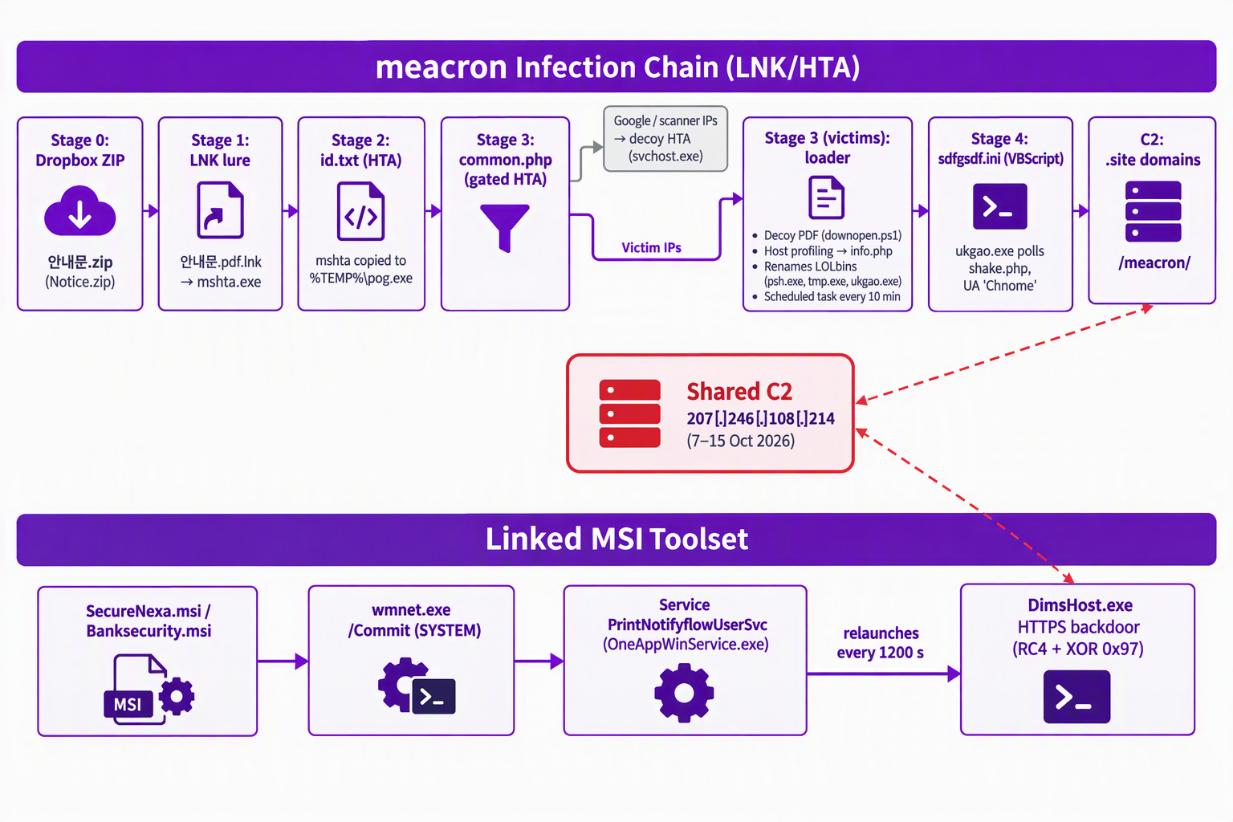
APEX Labs’ analysis of the infection chain showed that it begins with a Dropbox-delivered Korean-language Windows shortcut (LNK) file to kick off a series of HTAs that use living-off-the-land binaries (LOLbins)—legitimate Windows tools that attackers misuse—to deploy a VBScript implant that polls command-and-control (C2) for commands. The first toolset ran from web directories named /meacron/ on the actor's .site domains, with the stages, in order:
- Delivery. A Dropbox-hosted ZIP file contains an LNK file disguised as a PDF titled “Notice” in Korean (안내문). Windows File Explorer hides the .lnk extension by default, so the file looks like a document.
- First and second stages. The shortcut runs mshta.exe against a remote server. The HTA it returns copies mshta.exe to a temporary folder under a new name and uses the copy to fetch the next stage. A rule that matches only the original file name can miss that second request.
- Gated third stage. The server checks each requester. Requests from Google-owned IP ranges, which cover most automated sandboxes and scanners, receive a harmless decoy. Other requesters receive the real loader. APEX Labs confirmed 1 of these server-side checks.
- Host profiling. The loader downloads and opens a decoy PDF, then sends the names of running processes, recently opened files, the username, operating system details, the Microsoft Office version, desktop contents, and pinned taskbar shortcuts to the C2 server. The loader’s process check returns every process instead of looking for specific security products, which suggests the server decides whether security software is present.
- Persistence. The loader installs a VBScript implant. It copies and renames two built-in Windows tools, wscript.exe and schtasks.exe, and creates a scheduled task that runs the implant every 10 minutes.
- Final stage. The VBScript polls its C2 server using a misspelled browser name, “Chnome,” in its User-Agent header. If the server answers, the script decodes the reply and runs it without sending any output back. APEX Labs did not observe C2 responses during analysis, so the operator’s next action is unknown.
Fake security installers deliver a custom HTTPS backdoor
While analyzing the first toolset's infrastructure, APEX Labs found two MSI installers (Windows Installer packages) that imitated security software and contacted the same C2 server, 207[.]246[.]108[.]214, between 7 and 15 October 2026. Specifically, APEX Labs noted SecureNexa.msi (“Google Installer”) and Banksecurity.msi (“Bank Installer”) beaconing to the C2 server (207[.]246[.]108[.]214) during the same week (7–15 October 2026) that it was serving /meacron/good/id.txt, though we did not observe the original delivery method for these MSI installers. As of 5 November 2026, antivirus detections of the installers remained low, between 1 and 3 of 63 engines on a multi-engine scanning service. The embedded payloads were identical, and the two installers differed only in product name and build time.
At install, the package ran a helper program under the SYSTEM account, the highest privilege level on a Windows host. The helper copied the backdoor and a service program into the Windows folder and started an auto-start service named PrintNotifyflowUserSvc (display name “PrinterWorkflow”), which imitated the Windows print-notification service. The service relaunched the backdoor on an operator-controlled timer, so the backdoor returned after a reboot or after someone stopped its process.
DimsHost is the small custom backdoor associated with this campaign. It talks to its C2 server over HTTPS and can upload files, download files, create archives, run shell commands, and launch programs in the logged-on user's session. Code in the installer and the backdoor suggested further components that APEX Labs has not observed, because the installer tries to move a file the package does not ship and the backdoor carries an unreferenced keylogger string table.
Exhibit 3: MSI-delivered toolset components
| Artifact | Role |
|---|---|
| DimsHost.exe | Custom HTTPS backdoor |
| OneAppWinService.exe | Service that relaunches DimsHost.exe |
| wmnet.exe | Installer; run by MSI as SYSTEM |
| winmgr.ini | Config file containing the C2 address 207[.]246[.]108[.]214 |
| user_data.db | Defines the interval for OneAppWinService.exe to execute DimsHost.exe every 1,200 seconds (150 seconds if the file is missing or unreachable). |
Evidence links the activity to APT43 and connects the two toolsets
APEX Labs assesses that the threat activity we observed overlaps with the North Korean-linked threat actor APT43 (a.k.a. Emerald Sleet, Velvet Chollima). APEX Labs has high confidence in this assessment because the first toolset shared specific code with infection chains that threat research firm Kaspersky has documented for Kimsuky,1 a group whose activity mostly overlaps with the cluster Mandiant tracks as APT43.2 The same toolkit also traces back through 2023 and 2024 campaigns that public sources already track as Kimsuky.3, 4 The open-source Maltrail project also lists the 2023–2024 servers, their domains, and the /tlee43/ web path under Kimsuky.5 Finally, the Korean-language lure is consistent with the targeting Kaspersky reported for Kimsuky, which included South Korean media and a think tank in early 2022.
- Fingerprinting code. The stage-3 loader built its beacon address and sent host data in the same format, with the same variable names, as VBScript that Kaspersky documented. Kaspersky called the address pattern “the Kimsuky group’s usual URL format for fingerprinting.”6
- Misspelled User-Agent. The VBScript sent the same “Chnome” User-Agent that Kaspersky documented alongside a C2 script that served its payload only to requests that carried it.7
- Persistence pattern. An HTA loader installed a scheduled task that ran a VBScript disguised with an .ini file extension. Kaspersky documented a OneDrive-themed task built this way in 2022, and the 2023–2024 campaigns from the same shortcut-file build machine used a similar OneDrive-themed task name.
- Delivery pattern. The chain also overlaps with APT43 tradecraft, in which Korean-language lures deliver shortcut files and VBScript-based loaders, and C2 servers use .txt and .php file names to mask VBScript delivery.
APEX Labs assesses that the same operator runs both toolsets, based on infrastructure and timing. The backdoor's configuration file hard-coded 207[.]246[.]108[.]214 as its C2 server; that server also served the first toolset's stage-2 script during the same period, and the operator rotated servers every few days. The toolsets shared no code, strings, URL layout, or encryption.
- https://securelist.com/kimsukys-golddragon-cluster-and-its-c2-operations/107258/
- https://services.google.com/fh/files/misc/apt43-report-en.pdf
- https://github.com/stamparm/trails/blob/main/malware/apt_kimsuky.txt
- https://asec.ahnlab.com/en/55944/
- https://github.com/stamparm/trails/blob/main/malware/apt_kimsuky.txt
- https://securelist.com/kimsukys-golddragon-cluster-and-its-c2-operations/107258/
- https://securelist.com/kimsukys-golddragon-cluster-and-its-c2-operations/107258/
Indicators of compromise
74 indicators: 5 IP addresses, 16 domains, 25 URLs and 28 file hashes. Indicators are defanged: replace [.] with . and hxxp with http before loading them into security tools. URLs that contain <id>, <name> or <path> show a variable part of the address.
| Indicator of compromise | Type |
|---|---|
| 141[.]164[.]55[.]234 | IP address |
| 141[.]164[.]51[.]169 | IP address |
| 141[.]164[.]52[.]40 | IP address |
| 207[.]246[.]108[.]214 | IP address |
| 27[.]102[.]139[.]18 | IP address |
| clearglassenvironment[.]site | Domain |
| visitourhome[.]site | Domain |
| browsersecbrowsersec[.]site | Domain |
| welcomeoursite[.]site | Domain |
| coolautumnniceday[.]site | Domain |
| friendlycomcleaver[.]site | Domain |
| defendcore[.]site | Domain |
| visitourcom[.]site | Domain |
| onthewayfamily[.]site | Domain |
| warmenvironmetwarmhealth[.]site | Domain |
| rihyusimcloseme[.]site | Domain |
| ourfiendlycom[.]site | Domain |
| lovelyourland[.]site | Domain |
| myfirstcom[.]site | Domain |
| hugedrivercom[.]site | Domain |
| olkifmj[.]online | Domain |
| hxxps://www[.]dropbox[.]com/scl/fi/czxo60yjq10qpijjl6hsk/[.]zip?rlkey=xt83dju6xg8pt0v7n6wtj845z | URL |
| hxxps://clearglassenvironment[.]site/meacron/good/id[.]txt | URL |
| hxxps://coolautumnniceday[.]site/meacron/good/id[.]txt | URL |
| hxxps://visitourhome[.]site/meacron/good/common[.]php | URL |
| hxxps://coolautumnniceday[.]site/meacron/good/common[.]php | URL |
| hxxps://browsersecbrowsersec[.]site/meacron/good/redirect[.]php?m=docommon | URL |
| hxxps://browsersecbrowsersec[.]site/meacron/good/redirect[.]php?m=common | URL |
| hxxps://welcomeoursite[.]site/meacron/good/redirect[.]php?m=common | URL |
| hxxps://visitourhome[.]site/meacron/bad/shake[.]php | URL |
| hxxps://coolautumnniceday[.]site/meacron/bad/shake[.]php | URL |
| hxxps://browsersecbrowsersec[.]site/meacron/bad/welcome[.]php | URL |
| hxxps://browsersecbrowsersec[.]site/meacron/bad/info[.]php | URL |
| hxxps://friendlycomcleaver[.]site/ | URL |
| hxxps://defendcore[.]site/meacron/good/common[.]php | URL |
| hxxp://207[.]246[.]108[.]214/meacron/good/id[.]txt | URL |
| hxxp://207[.]246[.]108[.]214/meacron/good/common[.]php | URL |
| hxxps://207[.]246[.]108[.]214/index[.]php?name=<id>&mode=f | URL |
| hxxps://207[.]246[.]108[.]214/index[.]php?name=<id>&mode=up | URL |
| hxxps://207[.]246[.]108[.]214/index[.]php?mode=dw&fp=<name> | URL |
| hxxp://myfirstcom[.]site/meacron/good/redirect[.]php?m=docommon | URL |
| hxxp://myfirstcom[.]site/meacron/good/redirect[.]php?m=common | URL |
| hxxp://myfirstcom[.]site/meacron/bad/info[.]php?ki87ujhy=<path>&rdxvdw=<path> | URL |
| hxxp://myfirstcom[.]site/meacron/bad/welcome[.]php | URL |
| hxxp://myfirstcom[.]site/meacron/bad/shake[.]php | URL |
| hxxp://olkifmj[.]online/shiba/jegil/springroad19[.]php | URL |
| c71aa25c1f0b3a5ab3a3cf10650afaf071cd9bba2b2ecec10ba68faf0fef5541 | File hash (SHA-256) |
| 9d99a61fab56d3ba42ef55a3019fc9fbb9b4c6154ed080ef6fbb2af638def259 | File hash (SHA-256) |
| 00f12eb08e08d5285e6dc07e03584d129f183c283914f61938cb9ffee141b6c4 | File hash (SHA-256) |
| 0df60bedd0833d062ff4d46244ff1880a046a0badc91e971dfdb2ca461bd829d | File hash (SHA-256) |
| 32ad814ae159e798a3111a21ec2c242c808fdc6d838894619e11c2a720b19541 | File hash (SHA-256) |
| facd9b2277669342f8e12aab3836ac35e2934dbbd819f7923d56e4f68e84413b | File hash (SHA-256) |
| 024ed115348f10ea39e90cc762c26383ac069d78cbc7f12214419fc822d49b89 | File hash (SHA-256) |
| e52a16941be9c790bdbf6315b1f05d179cebf4cf0b95761e3f918a13b1b5fd03 | File hash (SHA-256) |
| c4b7a27b3ca81198e280463038f8ee789703c6e957093d4c64df397bd3dfaa02 | File hash (SHA-256) |
| fe7798dfc67538da80cdba4211048508bd2d84d0696af44ee0b44e7a0c8a970e | File hash (SHA-256) |
| bf2a6fe72c9584b2eaf1cf95b61ecd11c5511644d339d6c2a8fdcd23c3e5dfc4 | File hash (SHA-256) |
| 321c4a47ea1d02857145cc0ac62242bb27e66b89f88e9dfb5695cd014a0e8620 | File hash (SHA-256) |
| 452995c4e4c1e8fe06d439e0be0ac9acf77ac156d2910808ca01a9e0130517ba | File hash (SHA-256) |
| ad5afaa2c9edeca605e07c7267772e3957ca39907be3b81b4fe473bf4d4b8173 | File hash (SHA-256) |
| 52daa4c57ebb7f4a63c7fd356206f4d0dd7c136fe8292581a72f8a85f67fdd2a | File hash (SHA-256) |
| 85454d21919e7fd886e172b4ae636fa59e8c4297f3f8fdfab5b9367f0973eac9 | File hash (SHA-256) |
| 50e604f8776e2d08b7e95320df012a91d600cf60c63b8b0e8bf055521b6cedfa | File hash (SHA-256) |
| 9bf179c901320a91656941f62af7f113b182646a31dd765d4c59e850ff979ca4 | File hash (SHA-256) |
| 2f0f9359b5d2b53e9d0230c087de805c40c798703446c628b8bf34a5dbe867d7 | File hash (SHA-256) |
| d3d51fa3d2d128e95833832ff3ffa2d3b19267b0ea1fe260986cb157ead5a8a6 | File hash (SHA-256) |
| aaaac78ee6fd59f527e8f360ad93a0d028cb1e11159f90092c60b8c86a341289 | File hash (SHA-256) |
| 788809bfe3b849beb7949233f6e36f2db06cb21f2d7324360b2d3728cd7c6a42 | File hash (SHA-256) |
| c698e9e7eaf585b7cdeef34f2c4d3f22998014a48a10c639c137b2abc738fe5a | File hash (SHA-256) |
| f675f5cafb52f23503b74fa336d1ae281c76fd8f6ce494102799ebe92f27db98 | File hash (SHA-256) |
| 26a87654ffc0e669646517dd5f2ea41ec92ab34cb29c5e57f3ba1d53318642e2 | File hash (SHA-256) |
| e78e7fc96c8d2c67a9534b0460c14a5b6fdc96a228c1878ec90b15a5124fe764 | File hash (SHA-256) |
| d24dd00770ddd5fc69e615069279719b67efb3e0ab5879913762f50441f2ea6d | File hash (SHA-256) |
| 39ebf758e9da2f38d4eecc37685efddf0331d30abc3686dd05b5009dc966677e | File hash (SHA-256) |
Plain lists for bulk import (defanged)
IP addresses:
141[.]164[.]55[.]234
141[.]164[.]51[.]169
141[.]164[.]52[.]40
207[.]246[.]108[.]214
27[.]102[.]139[.]18
Domains:
clearglassenvironment[.]site
visitourhome[.]site
browsersecbrowsersec[.]site
welcomeoursite[.]site
coolautumnniceday[.]site
friendlycomcleaver[.]site
defendcore[.]site
visitourcom[.]site
onthewayfamily[.]site
warmenvironmetwarmhealth[.]site
rihyusimcloseme[.]site
ourfiendlycom[.]site
lovelyourland[.]site
myfirstcom[.]site
hugedrivercom[.]site
olkifmj[.]online
URLs:
hxxps://www[.]dropbox[.]com/scl/fi/czxo60yjq10qpijjl6hsk/[.]zip?rlkey=xt83dju6xg8pt0v7n6wtj845z
hxxps://clearglassenvironment[.]site/meacron/good/id[.]txt
hxxps://coolautumnniceday[.]site/meacron/good/id[.]txt
hxxps://visitourhome[.]site/meacron/good/common[.]php
hxxps://coolautumnniceday[.]site/meacron/good/common[.]php
hxxps://browsersecbrowsersec[.]site/meacron/good/redirect[.]php?m=docommon
hxxps://browsersecbrowsersec[.]site/meacron/good/redirect[.]php?m=common
hxxps://welcomeoursite[.]site/meacron/good/redirect[.]php?m=common
hxxps://visitourhome[.]site/meacron/bad/shake[.]php
hxxps://coolautumnniceday[.]site/meacron/bad/shake[.]php
hxxps://browsersecbrowsersec[.]site/meacron/bad/welcome[.]php
hxxps://browsersecbrowsersec[.]site/meacron/bad/info[.]php
hxxps://friendlycomcleaver[.]site/
hxxps://defendcore[.]site/meacron/good/common[.]php
hxxp://207[.]246[.]108[.]214/meacron/good/id[.]txt
hxxp://207[.]246[.]108[.]214/meacron/good/common[.]php
hxxps://207[.]246[.]108[.]214/index[.]php?name=<id>&mode=f
hxxps://207[.]246[.]108[.]214/index[.]php?name=<id>&mode=up
hxxps://207[.]246[.]108[.]214/index[.]php?mode=dw&fp=<name>
hxxp://myfirstcom[.]site/meacron/good/redirect[.]php?m=docommon
hxxp://myfirstcom[.]site/meacron/good/redirect[.]php?m=common
hxxp://myfirstcom[.]site/meacron/bad/info[.]php?ki87ujhy=<path>&rdxvdw=<path>
hxxp://myfirstcom[.]site/meacron/bad/welcome[.]php
hxxp://myfirstcom[.]site/meacron/bad/shake[.]php
hxxp://olkifmj[.]online/shiba/jegil/springroad19[.]php
File hashes (SHA-256):
c71aa25c1f0b3a5ab3a3cf10650afaf071cd9bba2b2ecec10ba68faf0fef5541
9d99a61fab56d3ba42ef55a3019fc9fbb9b4c6154ed080ef6fbb2af638def259
00f12eb08e08d5285e6dc07e03584d129f183c283914f61938cb9ffee141b6c4
0df60bedd0833d062ff4d46244ff1880a046a0badc91e971dfdb2ca461bd829d
32ad814ae159e798a3111a21ec2c242c808fdc6d838894619e11c2a720b19541
facd9b2277669342f8e12aab3836ac35e2934dbbd819f7923d56e4f68e84413b
024ed115348f10ea39e90cc762c26383ac069d78cbc7f12214419fc822d49b89
e52a16941be9c790bdbf6315b1f05d179cebf4cf0b95761e3f918a13b1b5fd03
c4b7a27b3ca81198e280463038f8ee789703c6e957093d4c64df397bd3dfaa02
fe7798dfc67538da80cdba4211048508bd2d84d0696af44ee0b44e7a0c8a970e
bf2a6fe72c9584b2eaf1cf95b61ecd11c5511644d339d6c2a8fdcd23c3e5dfc4
321c4a47ea1d02857145cc0ac62242bb27e66b89f88e9dfb5695cd014a0e8620
452995c4e4c1e8fe06d439e0be0ac9acf77ac156d2910808ca01a9e0130517ba
ad5afaa2c9edeca605e07c7267772e3957ca39907be3b81b4fe473bf4d4b8173
52daa4c57ebb7f4a63c7fd356206f4d0dd7c136fe8292581a72f8a85f67fdd2a
85454d21919e7fd886e172b4ae636fa59e8c4297f3f8fdfab5b9367f0973eac9
50e604f8776e2d08b7e95320df012a91d600cf60c63b8b0e8bf055521b6cedfa
9bf179c901320a91656941f62af7f113b182646a31dd765d4c59e850ff979ca4
2f0f9359b5d2b53e9d0230c087de805c40c798703446c628b8bf34a5dbe867d7
d3d51fa3d2d128e95833832ff3ffa2d3b19267b0ea1fe260986cb157ead5a8a6
aaaac78ee6fd59f527e8f360ad93a0d028cb1e11159f90092c60b8c86a341289
788809bfe3b849beb7949233f6e36f2db06cb21f2d7324360b2d3728cd7c6a42
c698e9e7eaf585b7cdeef34f2c4d3f22998014a48a10c639c137b2abc738fe5a
f675f5cafb52f23503b74fa336d1ae281c76fd8f6ce494102799ebe92f27db98
26a87654ffc0e669646517dd5f2ea41ec92ab34cb29c5e57f3ba1d53318642e2
e78e7fc96c8d2c67a9534b0460c14a5b6fdc96a228c1878ec90b15a5124fe764
d24dd00770ddd5fc69e615069279719b67efb3e0ab5879913762f50441f2ea6d
39ebf758e9da2f38d4eecc37685efddf0331d30abc3686dd05b5009dc966677eWhat this means for your organization
APEX Labs judges that blocking domains alone will not stop this threat actor, because it replaces them every 1–3 days and filters its servers so that most automated scanners see only a decoy. More behavioral indicators are likely to give defenders more to work with, including shortcut files that launch built-in Windows tools against remote servers, renamed copies of those tools, scheduled tasks that run script files, and a service that imitates a Windows component. But gaps remain, as APEX Labs did not observe how the fake installers reached victims or what the VBScript implant received from its C2 server.
Organizations based in South Korea are likely to be most at risk from this threat campaign. Although APEX Labs did not identify any specific victims, the Korean-language lure APEX Labs did identify, the earlier Korean lure names, and Kaspersky’s previous reporting that the associated Kimsuky group targeted South Korean media and a think tank in 2022 all suggest that the threat actor is likely targeting entities in South Korea. Government organizations, think tanks, and academic entities are likely to be most at risk based on our understanding of APT43’s historical targeting.
APEX Labs suggests defenders:
- Hunt for the misspelled User-Agent. Search proxy and web gateway logs for the “Chnome” User-Agent and for requests to a /meacron/ web path, because both appear in the first toolset.
- Review scheduled tasks that run script files. Look for tasks with random-looking names whose actions run VBScript from files that do not end in .vbs, because the first toolset hides its implant in an .ini file and runs it every 10 minutes.
- Detect renamed copies of built-in Windows tools. Compare each process’s original file name with its name on disk to find copies of mshta, PowerShell, schtasks, and wscript that run from temporary or application-data folders under new names, because the chain runs renamed copies of these tools.
- Restrict mshta.exe. Block or alert on mshta.exe launched by File Explorer with a remote web address and restrict the tool through Windows Defender Application Control (WDAC) or AppLocker where business requirements allow, because the chain starts when a shortcut file runs mshta.exe against a remote server.
- Control MSI installs. Block user-initiated installs from untrusted sources and require signed packages, because the second toolset arrives as fake security-software installers.
- Watch for services that imitate Windows components. Alert on creation of a service named PrintNotifyflowUserSvc (display name “PrinterWorkflow”), because the backdoor installer creates it to imitate the Windows print-notification service.
- Block current infrastructure and retro-hunt older indicators. Block the addresses and domains in Exhibit 1, including domains not yet seen in samples, and search historical logs for 207[.]246[.]108[.]214 and the older 2023–2024 infrastructure that Maltrail listed under Kimsuky.
- Remove the service before the files. If DimsHost is present, stop and delete the PrintNotifyflowUserSvc service before deleting files, because the service otherwise relaunches the backdoor.
- Use APEX Labs’ indicators. APEX Labs has published the full indicator list in the Indicators of compromise section of this page.