MiniGraph Playground – Executive Summary
An implementation of an in-memory property graph for computation and decision-making.
Overview
MiniGraph Playground is a graph-based application modeling and execution platform that enables rapid development of backend services, APIs, and decision logic — without writing application code.
At its core is the concept of an Active Knowledge Graph: a graph model that not only represents knowledge and relationships, but also executes behavior through embedded skills during graph traversal.
This approach allows organizations to:
- Build decision-centric and data-driven backend services
- Rapidly prototype and evolve business logic
- Decouple application behavior from traditional code deployments
What Is an Active Knowledge Graph?
Traditional property graphs model entities (nodes), relationships (edges), and attributes. MiniGraph extends this by allowing nodes to carry executable skills.
An Active Knowledge Graph:
- Encodes business knowledge as graph structures
- Assigns executable skills to selected nodes
- Executes logic dynamically as the graph is traversed
When traversal reaches a node with a skill:
- The graph executor invokes a composable function
- Inputs are derived from node attributes and the execution context
- The function returns a result
- The executor determines the next traversal path
This transforms a static knowledge graph into a living execution model.
Semantic Application Design
Active Knowledge Graph introduces a new paradigm called Semantic Application Development:
| Layer | Technology | Description |
|---|---|---|
| Semantic | Active Knowledge Graph | Application execution is based on derived knowledge — no imperative code required. |
| Composable | Event Script | Event choreography of independent, immutable functions. Roughly 50% config, 50% code. |
| Event-driven | Platform Core | Asynchronous, parallel processing of application logic through events. |
Why This Matters
Business Impact
- Faster time-to-market — Change logic by updating graph models, not code
- Lower risk — Dry-run and inspect execution paths before deployment
- Better alignment — Business rules, data, and execution live in one unified model
- Scalability — Execution is backed by a composable, event-driven architecture
Industry Context
MiniGraph aligns with — and advances — key industry trends:
- Graph-based decision engines
- Workflow and orchestration platforms
- Event-driven and composable architectures
- Low-code / no-code backend development
Unlike traditional workflow tools, MiniGraph models both knowledge and execution within a single graph.
Built-In Capabilities
MiniGraph Playground ships with built-in skills for common enterprise needs:
- Data mapping and transformation
- Mathematical and logical evaluation
- External API integration
- Cross-graph execution
- Orchestration and branching control
These capabilities allow complex backend behaviors to be composed visually and executed reliably.
Governance and Lifecycle
MiniGraph supports a structured, enterprise-grade development lifecycle:
- Create graph models interactively
- Test and validate individual skills
- Perform full dry-run executions
- Certify graph behavior
- Deploy to non-production environments
- Execute functional and performance tests
- Promote models through staging
- Approve and deploy to production
Once deployed, a graph model is invokable as a standard API endpoint or event listener.
Strategic Value
MiniGraph Playground enables organizations to:
- Externalize business logic from application code
- Standardize execution patterns across teams
- Improve observability and explainability
- Build adaptable systems resilient to change
It represents a shift from application-centric development to knowledge- and execution-centric design.
Technology Review
Figure 1 – Architecture Diagram
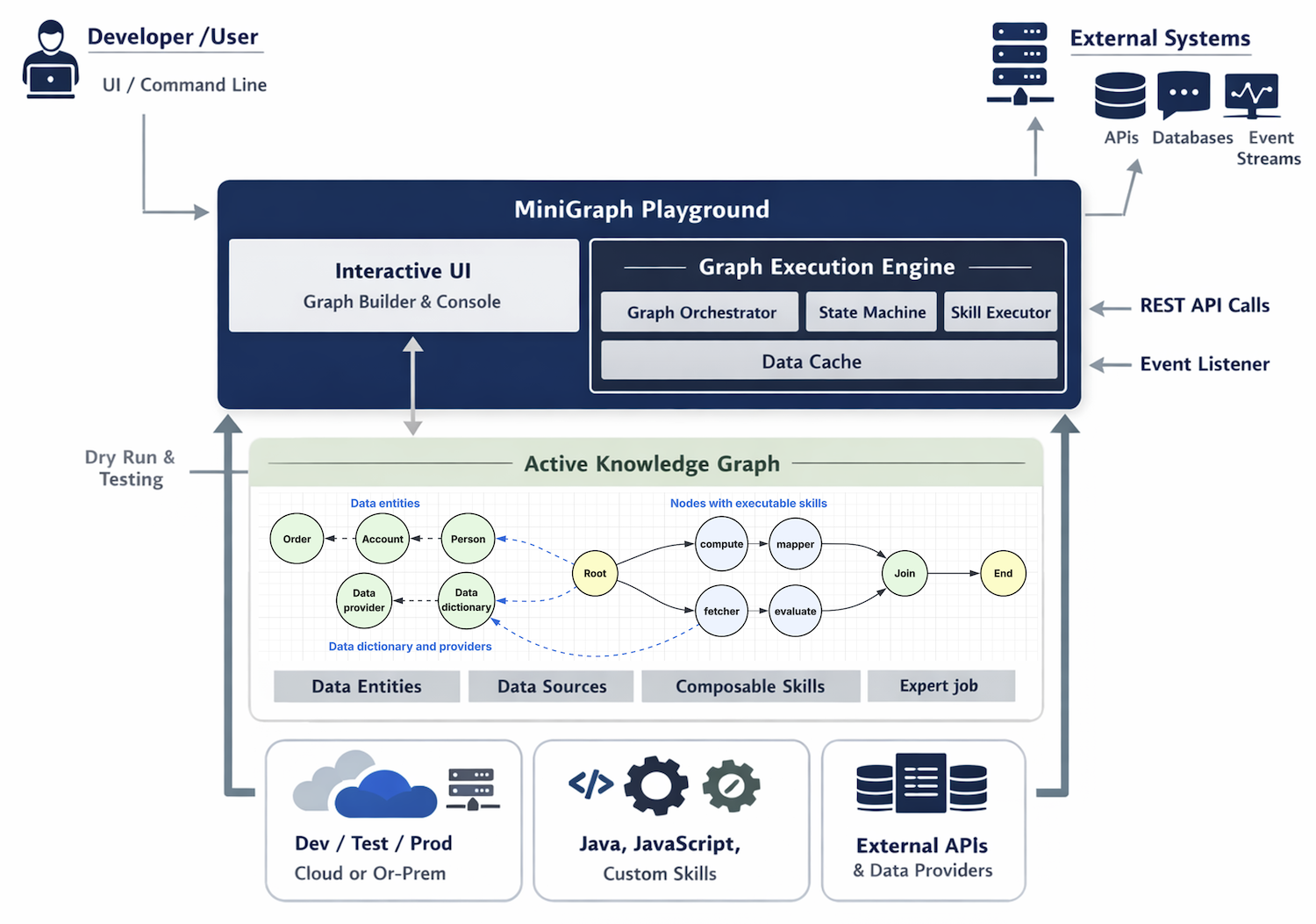
MiniGraph Playground is a developer-focused environment for creating, testing, and executing Active Knowledge Graphs. It provides both a graph execution engine and a self-service interactive UI, enabling developers to model backend logic, decision flows, data access, and orchestration using graph structures and composable skills.
Core Concepts
Active Knowledge Graph
An Active Knowledge Graph is a directed graph with:
- A root node — the execution entry point
- An end node — the execution completion marker
- One or more nodes configured with executable skills
Traversal begins at the root and continues until the end node is reached, or until traversal is intentionally paused or redirected.
Node Types
MiniGraph supports three primary node categories:
1. Data Entity Nodes
Represent business entities and their attributes — what the system knows.
Examples: Person, Account, Order
2. Data Dictionary & Provider Nodes
Define external data sources and API contracts, including:
- Attribute definitions
- Endpoint configurations
- Request and response mappings
These nodes enable integration with external systems.
3. Skill Nodes (Active Nodes)
Execute actions during traversal, including:
- Computation
- Decision making
- Data fetching
- Flow control
Skill nodes are the behavioral backbone of the graph.
Skills and Execution Model
A skill is implemented as a Composable Function — self-contained, event-driven, and stateless.
During execution:
- The graph executor sends input to the skill
- The skill executes and returns a result
- The executor updates the graph state machine
- Traversal continues based on the outcome
Built-In Skills
| Skill | Description |
|---|---|
graph.data.mapper |
Maps data between nodes |
graph.math |
High-performance math and boolean evaluation (Java) |
graph.js |
JavaScript-based expression evaluation (more flexible, but slower) |
graph.api.fetcher |
Invokes external APIs using data dictionary definitions |
graph.extension |
Executes another graph model |
graph.island |
Pauses traversal to isolated subgraphs |
graph.join |
Synchronizes multiple execution paths |
Each skill has its own help page with syntax, parameters, and examples.
Interactive Development Experience
MiniGraph Playground provides:
- A command prompt for graph operations
- Console output with execution details
- Visual graph rendering via
describe graph
The environment is intentionally playful and exploratory, designed to encourage incremental modeling and validation.
Testing and Dry-Run Execution
Developers are encouraged to:
- Execute individual skill nodes
- Inspect intermediate state machine data
- Validate traversal paths visually
A dry-run starts at the root node, traverses the graph using mock input, displays execution paths and outputs, and requires no live system dependencies.
Deployment Model
After validation, graph models are deployed to cloud environments and exposed via a generalized API endpoint: /api/graph/{graph-id}
Execution is decoupled from protocol using Event Script, enabling:
- REST invocation
- Event-driven execution (e.g., Kafka)
- Future protocol extensions
Help System
MiniGraph includes comprehensive built-in help covering:
- Node creation, editing, and deletion
- Graph traversal and execution
- Import/export
- Data dictionary configuration
- Skill-specific usage
Help pages are accessible directly from the Playground UI and serve as the primary learning resource.
Extensibility
Graph models can be extended in four ways:
- API Fetcher Feature — Add a small software component to pre- or post-process API requests and responses (e.g., handling OAuth2 bearer tokens).
- Graph Extension — Connect one graph model with one or more others to build larger capabilities.
- Flow Extension — Integrate a graph model with one or more event flows to delegate complex processing to composable software modules.
- Custom Graph Skill — In exceptional cases, create a new reusable graph skill. Note: this is reserved for graph execution engine development and is not recommended for user application development.
Summary
MiniGraph Playground enables developers to model backend logic visually, execute complex flows without orchestration code, test and validate behavior early, and deploy production-ready graph-based services — bridging graph modeling, event-driven execution, and composable design into a single, coherent developer experience.
Glossary
Active Knowledge Graph — A property graph extended with executable skills on nodes; logic executes during traversal.
Active Node / Skill Node — A node configured with a skill that runs during traversal (compute, decision, fetch, or flow control).
Composable Function — A self-contained, stateless, event-driven function that can be invoked independently and reused across graphs.
Data Cache — Runtime cache used by the execution engine to store intermediate values and reduce repeated lookups.
Data Dictionary Node — A graph node describing data attributes and external contract definitions (schemas/mappings).
Data Entity Node — A graph node representing a business entity and its attributes (e.g., Person, Account).
Data Provider Node — A graph node defining how external data is accessed (endpoint configuration, request/response mapping).
Dry-Run — A non-production execution that traverses the graph using mock input, displaying execution paths and outputs without requiring live dependencies.
End Node — Terminal node marking execution completion.
Event Script — Event choreography of composable functions; used as a protocol-decoupling layer enabling REST or event-driven invocation of graph execution.
Execution Context — Inputs and runtime state passed between skills and used to evaluate branching.
Graph Execution Engine — Runtime responsible for orchestrating traversal, invoking skills, managing state, and caching.
Graph Extension — A composition pattern where one graph invokes another to build larger capabilities.
Graph Orchestrator — The component that coordinates traversal steps and skill invocation sequencing.
Island — An isolated subgraph execution pattern that pauses traversal for containment or staged processing.
Join — A synchronization mechanism that merges multiple execution paths.
Property Graph — A graph model where both nodes and edges can hold properties/attributes.
Root Node — The entry point for graph traversal and execution.
Semantic Application Development — A paradigm where execution is driven by derived knowledge represented in an Active Knowledge Graph, rather than imperative application code.
Skill Executor — The component that invokes skills and handles their results.
State Machine — The runtime component that tracks traversal state, transitions, and branching outcomes.
| Chapter-10 | Home |
|---|---|
| Mini-Graph | Table of Contents |