SABSA Security Architecture
MethodAtlas ships with a complete SABSA security-architecture library. It is the document that answers, element by element, why this tool is trustworthy enough to produce audit evidence — and lets a reviewer trace every claim back to a business reason.
This page explains what SABSA is, walks through its layers, and shows how MethodAtlas applies the method to itself. The full architecture document — all 199 elements, their traceability and the evidence behind each — is published in full as The MethodAtlas SABSA Architecture, generated from the approved library.
What SABSA is
SABSA (Sherwood Applied Business Security Architecture, maintained by the SABSA Institute) is a framework for building security architectures that are driven by business need rather than by technology. Its central discipline is simple and strict: every security decision must trace upward to a business reason. A mechanism exists because a service needs it; the service exists because an objective requires it; the objective exists because a measurable business attribute demands it; the attribute exists because a business driver stated it. Nothing is included "because it is good practice" — it is included because something above it needs it.
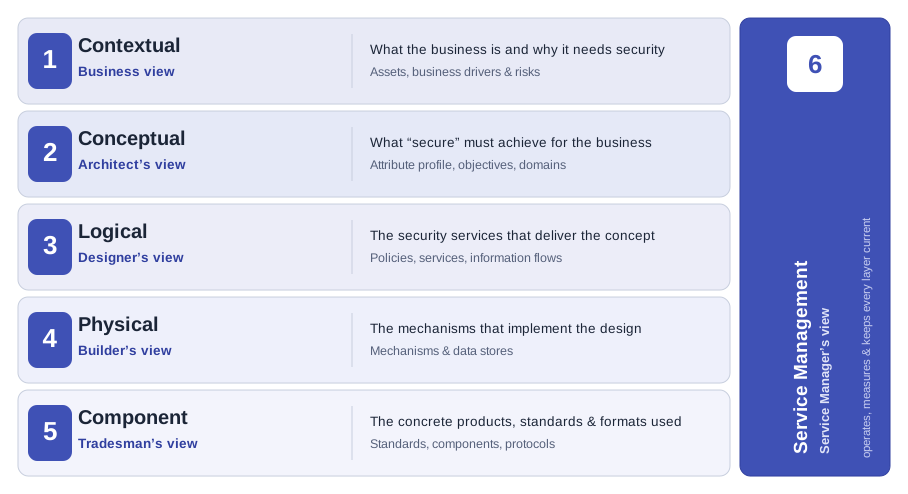
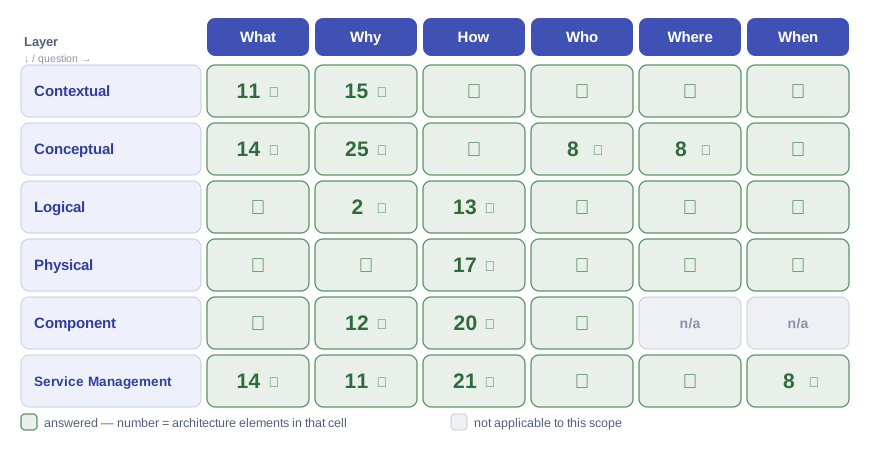
SABSA organises that chain as a stack of six layers, each written from the viewpoint of a different role, and asks the same six questions — What, Why, How, Who, Where, When — at every layer. The result is a 6×6 grid in which each cell has an owner and an answer.
The six layers
Each layer re-expresses security at a different level of abstraction, from the business that needs it down to the concrete components that deliver it. A sixth layer, Service Management, runs vertically across all of them: it is how the architecture is operated, measured and kept current.
| Layer | View | The question it settles |
|---|---|---|
| Contextual | Business view | What the business is, and why it needs security at all. |
| Conceptual | Architect's view | What "secure" means here — expressed as measurable attributes. |
| Logical | Designer's view | The security services and information flows that deliver the concept. |
| Physical | Builder's view | The mechanisms and data structures that implement the design. |
| Component | Tradesman's view | The concrete products, standards and formats that make up the mechanisms. |
| Service Management | Service manager's view | How security is operated, measured, supported and kept current. |
See The Six Layers for what each layer actually holds in the MethodAtlas library.
The 6×6 matrix
The six layers and the six questions form the SABSA matrix. MethodAtlas's library settles all 36 cells — every layer answers every question, or records why a question does not apply at that layer. The number in each cell is how many architecture elements sit behind that answer.
The golden thread — traceability
The point of SABSA is not the grid; it is the thread that runs through it. Every component in the library can be followed upward — through the mechanism that uses it, the service it belongs to, the control objective it meets, the business attribute it supports — to the business driver that justifies its existence. MethodAtlas records this chain explicitly for every element.

How MethodAtlas applies SABSA to itself
SABSA is normally applied to a business and its estate. MethodAtlas applies it to its own trustworthiness — the security architecture of the product as it is built, maintained and released, not the security of any one customer's deployment. The "asset" the architecture protects is the trustworthiness of MethodAtlas's output and of the process that produces it — its reason to exist for a regulated-industry audience.
The library at a glance
199 elements across the six layers — 11 business drivers, 15 risks, 14 measurable attributes, 14 control objectives, 8 domains, 8 trust relationships, 11 architecture decisions, 13 logical services, 17 mechanisms, 12 standards, 20 components, and the service-management set (14 measures, 14 evidence artefacts, 7 operations, 11 exceptions, 8 roadmap items). The library (version 6.1.0) is owner-approved against a hash-bound snapshot, so the document and the model cannot silently disagree.
What "secure" means here — the attribute profile
At the Conceptual layer, "secure" is made concrete as a profile of fourteen measurable business attributes, each with a definition, a metric, a measurement method and a target. They are what turn trust from a claim into something the project can observe on its own builds:
| Authentic | Reproducible | Bounded |
| Taxonomy‑Stable | Schema‑Stable | Supply‑Chain‑Intact |
| Data‑Minimising | Confidential | Verifiably‑Tested |
| Supportable | Credible | Transparent |
| Audit‑Trail‑Intact | AI‑Result‑Reproducible |
Each attribute is driven by one or more of the eleven business drivers (BD‑001…BD‑011) and is measured by the service-management layer's measures and evidence — closing the loop from "what the business wants" to "evidence that we have it, regenerated on every build".
Where this connects
The attribute profile is the architectural backbone behind MethodAtlas's product promises: determinism (see Reproducibility Receipts), bounded AI (see Security Taxonomy), data minimisation (see Data Governance) and the audit trail (see Audit Trail).
The full architecture document
This page is an orientation. The authoritative SABSA document — the executive summary, every layer with all six questions answered, the full attribute profile with metrics and targets, the governance register, the element register and the complete traceability table — is published here in full, generated from the library so the document and the model can never drift: